One thing to be clear about first: none of this is private data. It is read from published programs, and the value is not that the figures are hidden — it is that reading 215 programs and reconciling 5,984 people into distinct identities is work nobody wants to do once a year.
What if you could know which topics are trending over the last few years in conferences of your size, in or around your location, the patterns in which speakers take the stage, and how your own editions read against the practice?
Rising, falling, and flat
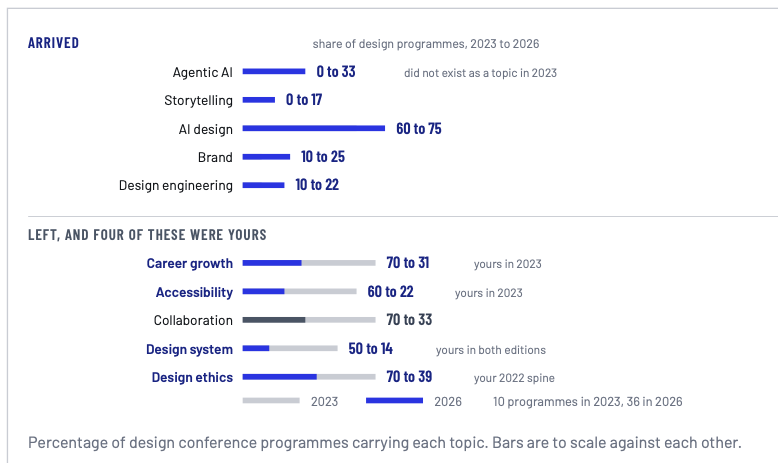
Is this topic early, or third in a row?
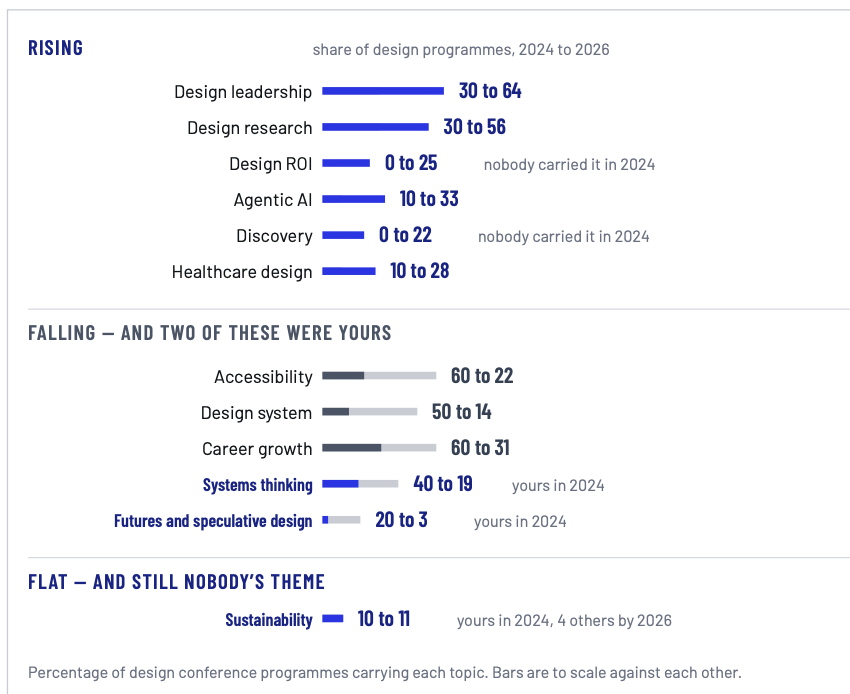
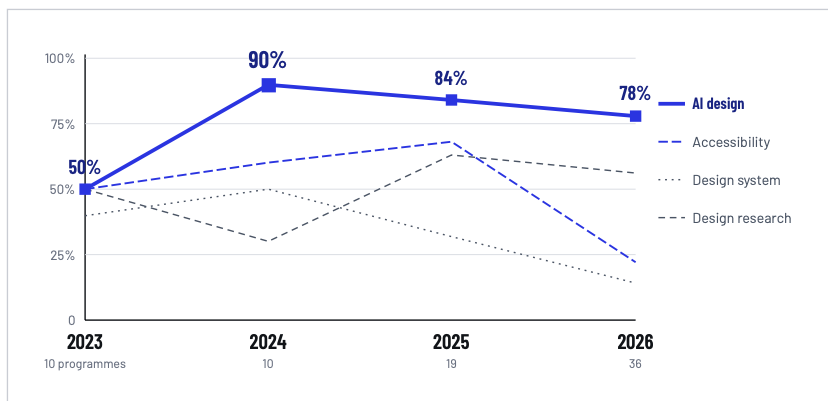
A topic that four in five programs already carry is table stakes, not a draw. The index can tell you which subjects arrived, which are flat, and which the field has quietly dropped — as a share, so the growth in coverage is taken out.
Who has been on which stage
Which of your speakers appear elsewhere, where, on what, and how recently. Which of your peers' stages they have been on. And where your own program had someone first, sometimes years before the circuit.
Our insights for each conference
Every conference is unique — its program, its history, its theme, location and audience. So each report is read for that conference rather than run off a template. Five examples, from five different conferences.
The visual is specific for a conference, the numbers are taken from a set of five or six conferences in a specific region, and for one category of conferences.
Choose an example
What arrived, and what left
A topic over four years, as a share
Rising, falling, and flat
Speakers you had first
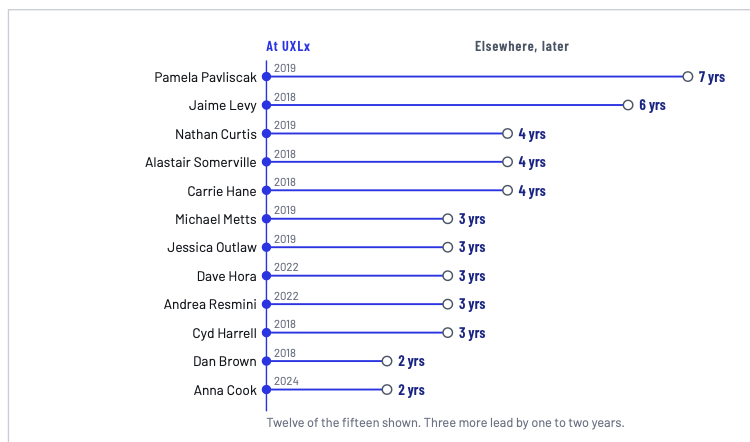
Is there a circuit to differentiate against?
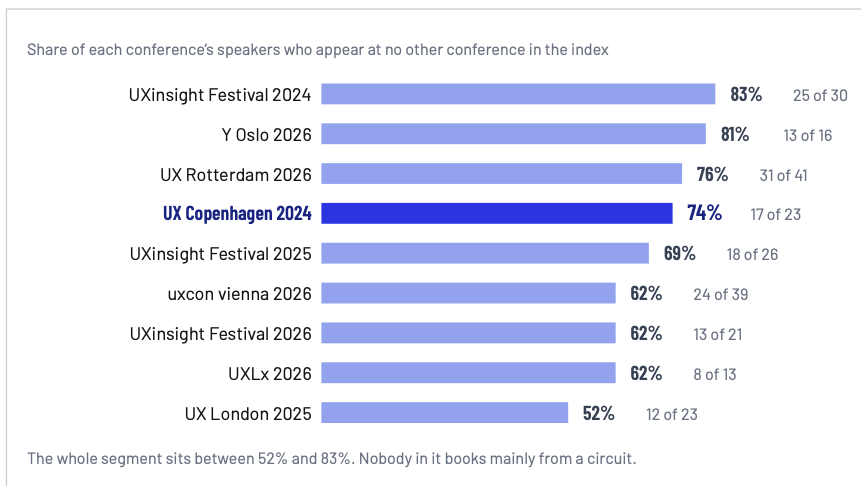
Every figure is read from an organizer’s own published program — no attendee data, no revenue, nothing unpublished. Yours would be read the same way.

Stippi is read by
Vinish Garg
Twenty years of work moving from content strategy to design to product leadership across domains, with product teams worldwide — and the best part of it is being with the conferences as a volunteer, a speaker and a follower. I teach design and content in the master's program in Austria, and my own seven talks are in the index, read in exactly the same way as everyone else's.
Every program here was read by hand from the organizer's own page, one at a time, and each record carries the date it was read. There is no scraper.
Want one for your conference?
Tell me which conference you run and I will read your program against the practice — your category, your region, the last four to five years. You will get that back within two weeks, as a short report. If there is something worth doing beyond it, we will talk about scope then.